Keep AdSense, sell direct on top
Keep AdSense running. It is your floor, not your ceiling. Google's programme policies do not require exclusivity, checked against their placement policies on 16 September 2026, so the arrangement that works is your own direct deals first, with AdSense filling what you have not sold.
Nothing in the AdSense policies says it has to be the only thing on your site.There is no exclusivity clause. Publishers run their own direct-sold campaigns alongside AdSense all the time. What the policies care about is invalid clicks, deceptive placement and what your content is, and none of those change because you sold a banner yourself. Google does revise its policies, so read the current versions on Google's own site before you change anything. Checked 16 September 2026.
What AdSense actually is
AdSense is demand. You paste a tag, Google auctions the space to advertisers it already has, and money arrives without you speaking to anybody.
It fills a slot with no rate card, no media kit and no audience description, which is why it makes a good floor under your own sales.
What it does not give you is a price, a customer or a relationship. You take what the auction finds.
What Pyrobid is
Pyrobid is the ad server, not the demand. It puts a self-serve portal under your own brand where an advertiser you found funds an account and bids for your space above the floor you set.
The advertisers are yours: it does not broker them, and it never takes a share of the deal. It is $29.99 a month, and the fallback tag underneath it is yours to choose.
The two do different jobs. Running both is the normal answer, not a compromise.
What AdSense will never do for you
A network fills the slot. It does not sell it, price it, or introduce you to anybody.
Your price, and all of it
AdSense decides what your audience is worth and keeps a share for arranging it. On your own portal you publish a floor price, the advertiser bids at or above it, and the whole amount is yours. No grading, no rate review, no cut.
A buyer with a name
A network hands you anonymous demand that can be re-rated or switched off without a conversation. A direct advertiser is a relationship, a renewal and an asset, and the ones already emailing you about rates are the easiest money on the internet.
Nobody can disable your account
Policy decisions, invalid traffic holds and suspensions are somebody else's to make. Placements you sell yourself are not subject to review, and restricted verticals are welcome here in writing.
Keep AdSense underneath
None of this means turning it off. Your direct deals fill first at your price and anything unsold falls through to AdSense.
Side by side
AdSense here means the standard content programme, described as Google publishes it, checked 16 September 2026. The Pyrobid column describes the product as sold.
 $29.99/mo
|
AdSenseFree to join | |
|---|---|---|
| What you are actually getting | ||
| What it is | An ad server you run | A source of demand |
| Who finds the advertiser | You do | Google does |
| Who sets the price | You do, per slot | The auction does |
| What it costs | $29.99 a month, flat | Free to join, Google keeps a share of the revenue |
| Share taken from your direct deals | None, ever | Not applicable |
| Control | ||
| Branding on the buying experience | Your portal, your domain | No advertiser relationship to brand |
| Floor price per slot | ✓ | Google runs the auction |
| Targeting you control | Country, device, ISP, dayparting, keywords, frequency | Google decides the match |
| Refusing a particular advertiser | You approve every creative | Blocking controls only |
| Who you can invoice | Anybody, paid any way you like | Nobody, Google pays you |
| Where it can serve | ||
| Fill on a new site with no audience story | You still have to sell it | ✓ |
| Crypto, cannabis and gambling publishers | Supported and stated | Google publisher policies apply |
| Runs alongside the other one | ✓ | ✓ |
We do not print an AdSense revenue share figure here. Google publishes that themselves and it is theirs to change.
Where Pyrobid wins
Not against AdSense. On top of it.
The rate you set, not the rate the auction finds
Ad network rates on most small English-language sites run roughly $0.30 to $2.00 per thousand views. Direct deals on the same inventory run roughly $4 to $35. The gap is not magic. It is the value of a buyer who wants your specific readers rather than a demographic they were matched into.
No revenue share on what you sell
$29.99 a month and nothing on top, whether you bill an advertiser $50 or $50,000. The software does not take a cut of your sales work.
A customer instead of a payment
An advertiser who buys through your portal has your email address, a login and a reason to come back next quarter. Renewals are most of the business once you have a few. A network payment does not renew. It just arrives smaller when traffic dips.
Verticals Google will not take
If you publish about crypto, cannabis, igaming or trading, Google publisher policies may limit or block what AdSense will serve on your pages. Direct is how those sites get paid, and we say so out loud rather than in a footnote.
One account cannot switch off all your income
Any single demand source can change its rules, its rates or its mind. A book of direct advertisers is the part of your revenue nobody else controls, which is the whole argument for running both rather than either.
What your advertisers see
Your brand, on your own domain. They sign up, fund an account and build a campaign in five steps. You approve the artwork before anything runs.
Illustration of step one of the advertiser campaign builder, on your own domain under your branding.
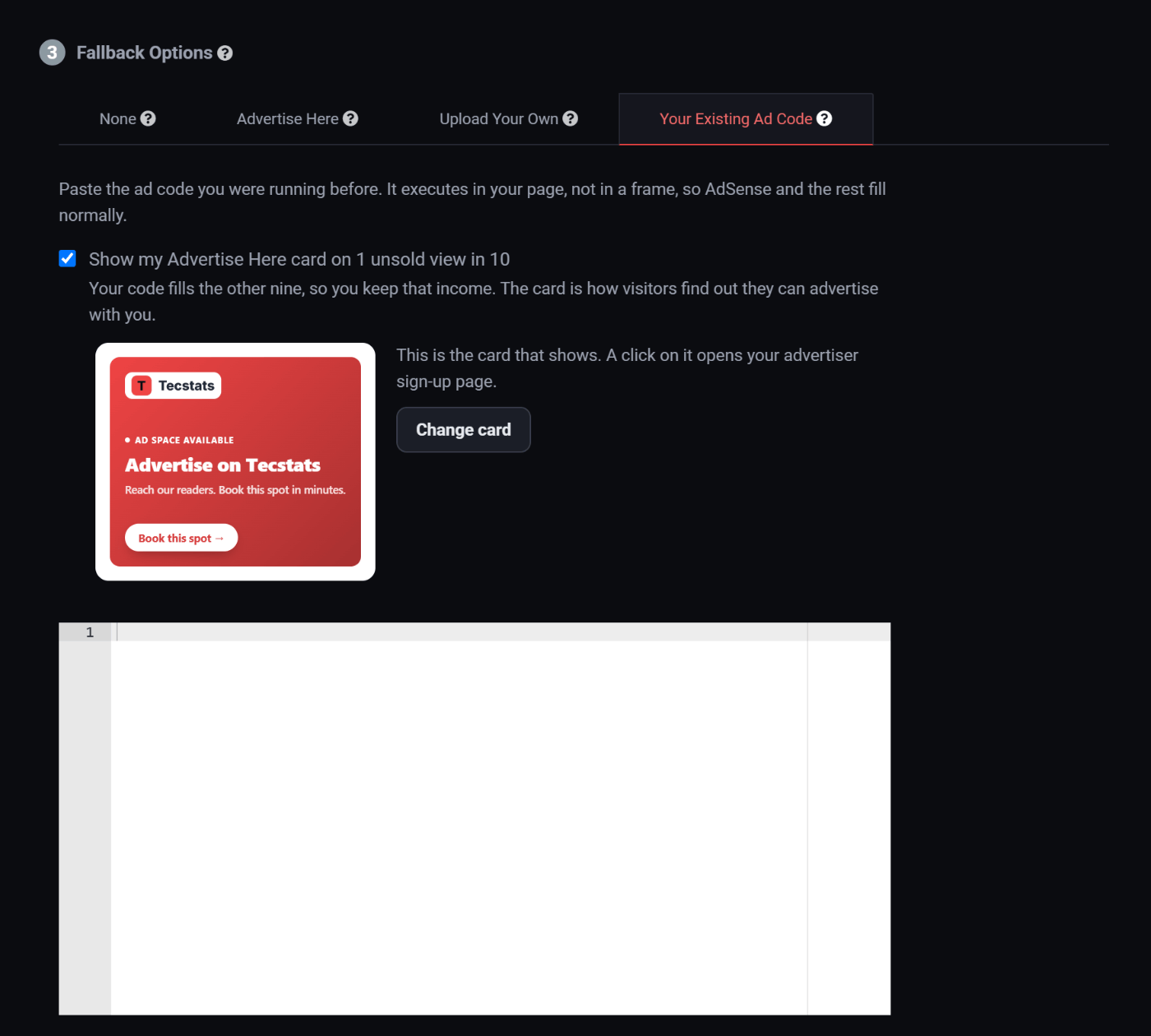
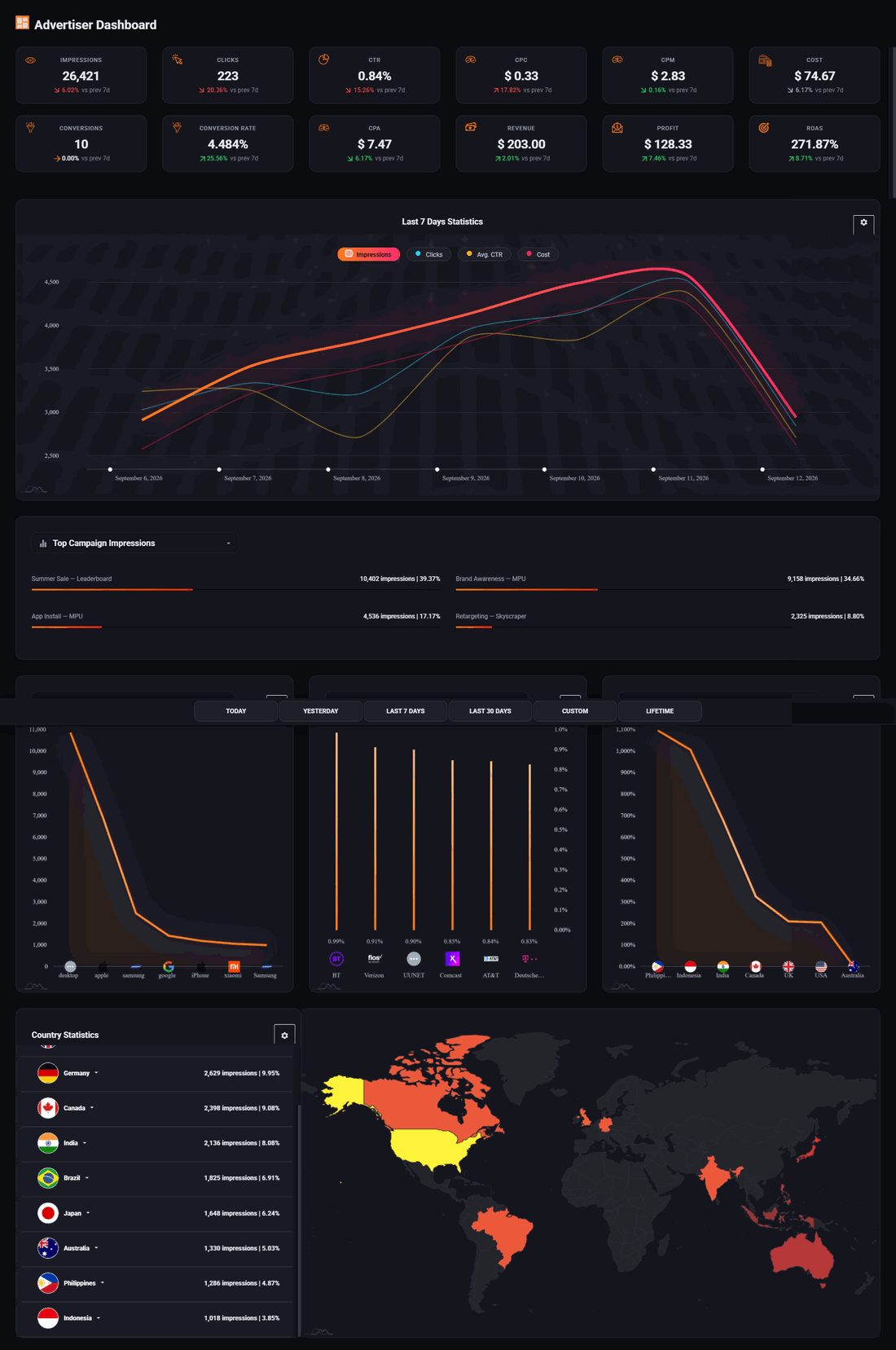
A screenshot is still only a picture. The demo is the running product, read only, with the login published and nothing to install.
How the fallback actually works
Pyrobid asks your direct campaigns first. Every slot has a floor price. Bids below it are discarded and the slot falls through to the fallback, rather than serving something cheap because it was the only thing there.
The fallback code is your AdSense tag, pasted into the zone once. It executes in the page rather than inside an iframe, which is the technical reason AdSense fills normally underneath instead of coming back blank.
That is all a passback is. Passback explained goes through it slowly, and how it works covers the rest of the chain.
What to sell first
Not everything. Take the one placement an advertiser would ask for by name, usually the unit high on your best page, and sell that at a real rate. Leave every other slot on AdSense and forget about them.
One slot sold properly is worth more than seven slots half sold, and it is far less work. The rate planner will do the arithmetic on what a slot should cost, and keeping AdSense while selling direct is the longer version of this page.
Your network keeps what you do not sell
Every ad request runs down a chain. Your direct deals get first refusal at your price. Anything unsold falls through to what you run today.
Your AdSense earnings will go down. That is what success looks like.Every impression you sell direct is an impression AdSense no longer gets to auction, so the figure in your Google dashboard falls in the first month. Publishers see the drop, panic, and pull the direct campaigns before the invoices have even been paid. Watch the total instead. The arithmetic is below.
Side by side
A worked example on one slot doing 500,000 impressions a month. The rates are made up to show the arithmetic. Yours will be different.
|
AdSense underneath
|
AdSense onlyWhat you do today | |
|---|---|---|
| The same slot, two ways | ||
| Impressions in the month | 500,000 | 500,000 |
| Sold direct at $8.00 per thousand | 100,000 impressions, $800 | None |
| Filled by AdSense at $1.00 per thousand | 400,000 impressions, $400 | 500,000 impressions, $500 |
| What your Google dashboard shows | $400, down by a fifth | $500 |
| What you actually earned | $1,200 | $500 |
| After the $29.99 for Pyrobid | $1,170.01 | $500 |
The $1.00 and $8.00 rates are example figures picked inside the ranges we publish elsewhere: roughly $0.30 to $2.00 per thousand from a network on most small English-language sites, roughly $4 to $35 direct. We are not predicting your numbers, and neither should anybody else.
The rules that still apply, none of which are new
Selling direct changes nothing about how you have to behave with AdSense. These were the rules before you started.
Never click your own ads
Not once, not to check it works, not to show a friend how it looks, and never ask anybody else to. Invalid click activity is the fastest way to lose an AdSense account, and it has nothing to do with whether you also sell direct.
No placement designed to cause mistaken clicks
An ad sitting where a button or a download link should be is a policy problem whether Google served it or you did. Keep a new direct slot clearly separated from the AdSense unit and from anything the reader is trying to click.
Label advertising as advertising
A direct-sold banner is an ad and should read as one. Mark sponsored placements clearly. This is Google policy, it is advertising law in most countries, and it is what an honest page looks like.
Content policies still apply
AdSense will not serve on content Google does not allow, and putting a direct campaign on the same page does not change that. If your subject is one Google restricts, direct sales are how you monetise it, not a way to keep AdSense running on pages that break the rules.
Check the ad unit limit yourself
Google has published limits on how many ad units a page may carry, and that policy has changed over the years. We are not going to print a number that might be wrong by the time you read it. Read Google's current published policy before you cut another slot into the page.
Choose Pyrobid if
- ›Somebody has already emailed asking to buy space from you
- ›Your readers are a specific group an advertiser could name
- ›You publish in crypto, cannabis, igaming or trading
- ›You will answer an advertiser email within a day
Sell the slots worth selling, and run AdSense under the rest.
Common questions
Will selling direct get my AdSense account banned?
No. There is no exclusivity requirement in the programme policies. Accounts get into trouble over invalid clicks, deceptive placement and content that breaks the content policies. None of those are caused by selling a banner yourself. Keep to the rules above, which are the same rules you were already keeping to.
My AdSense earnings dropped the month I started. What did I break?
Nothing. You moved your best impressions to a buyer paying several times more, so there are fewer impressions left for Google to auction. The dashboard figure falls and the total goes up. That is the whole point of the worked example above: compare total revenue month on month, not the AdSense number on its own.
Should I take AdSense off a slot I have sold direct?
No. Leave it underneath as the fallback. A direct campaign is capped, day-parted and finite, so there will be hours and days when it has nothing to show, and an empty slot earns nothing at all. The fallback fills those, and it fills them with the same code you are running today.
Is AdSense an alternative to Pyrobid, or the other way round?
Neither, and the search term is misleading. AdSense is a source of demand: Google brings the advertisers and the auction sets the price. Pyrobid is an ad server: it serves, targets and bills the advertisers you bring, at prices you set. One is a buyer and the other is the machinery. Most sites should run both.
How many ad units can I have on a page now?
Read Google's current published policy and take the number from there, not from us. It has changed before and a figure printed on a marketing page ages badly. Worth saying separately: more units is not more money. Every slot you add competes with the ones already there for the same attention, and a cluttered page is worth less to a direct advertiser than a clean one.
What if my site is in a vertical Google restricts?
Then direct is not an upgrade, it is the only route. Google publisher policies limit or block serving on plenty of legal businesses, including much of crypto, cannabis and gambling. Pyrobid does not care what you publish, because we are software and we never touch the money between you and your advertiser. You take payment however suits you, including bank transfer, invoice or stablecoin, and issue the advertiser a voucher that redeems as ad credit.
Keep AdSense. Sell direct on top.
Fourteen days free, $29.99 a month after that, and no revenue share on anything you sell. Your AdSense units carry on filling what you have not sold, starting on day one.
Start free trial14 days free. Your existing ads keep running. Cancel anytime.
The AdSense policy points on this page are a plain-English reading of Google's published programme and publisher policies as at 16 September 2026. They are not quotations and they are not legal advice. Google revises those policies, so check the current versions on Google's own site before you act, particularly anything about how many ad units a page may carry. We state no AdSense revenue figure, because the only honest one is the figure in your own account. The rate ranges are ranges on purpose: roughly $0.30 to $2.00 per thousand from a network on most small English-language sites, and roughly $4 to $35 direct on the same inventory.