
For site owners
Set your floor price
What the number means, how other countries are priced from it, and why too high earns nothing.
One number decides whether a slot earns well, earns a little, or earns nothing at all. It is the easiest thing on the whole form to get wrong, and the mistake almost everybody makes is setting it too high.
The question the form asks
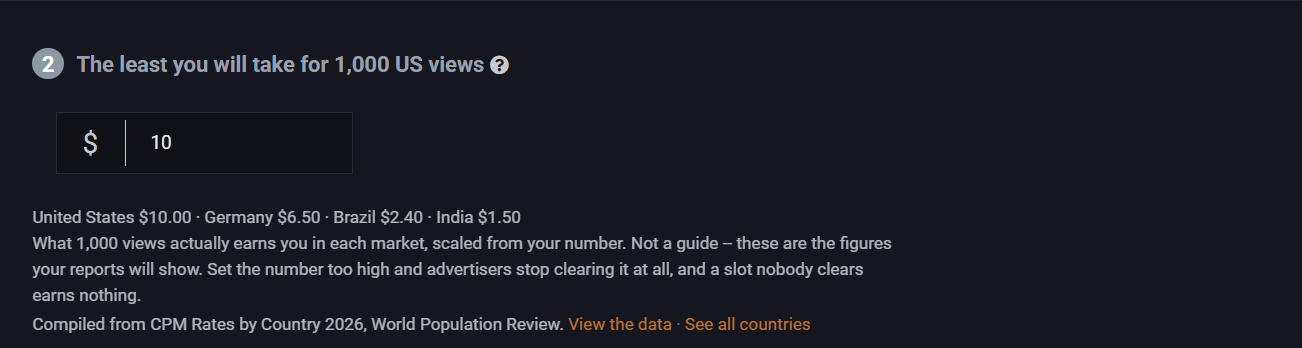
Your price for 1,000 views from the United States. Not per click, not per day. A thousand times the ad is drawn on one of your pages, for somebody in the United States.
The industry calls that a CPM, cost per mille, mille being a thousand. You will see the letters everywhere once you start reading your reports.
It is a floor, not a price
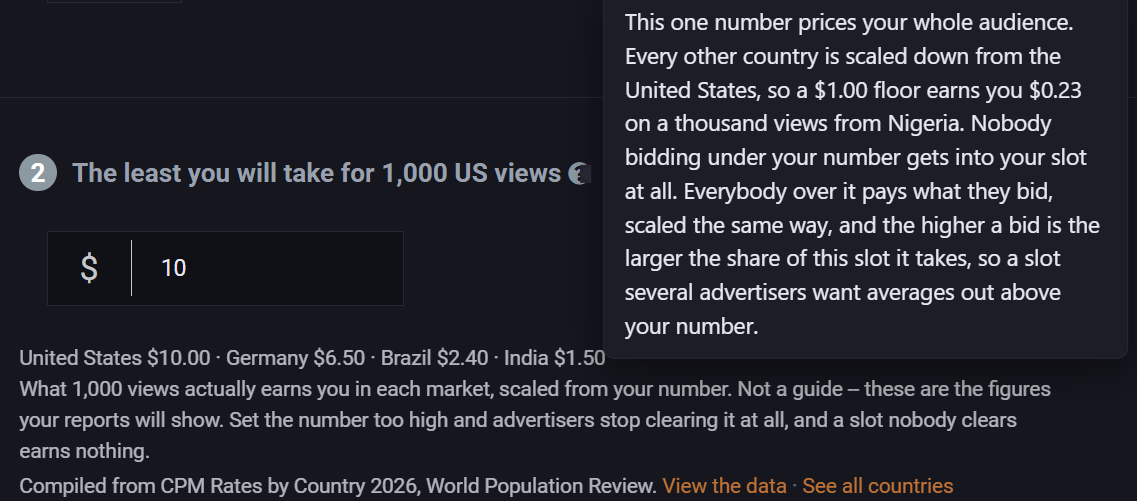
Nobody buys below this price. That is all it does. It does not say what you get, it says what you refuse.
Every other country is priced as a share of this one number, so the single figure settles the whole scale. An advertiser who will not meet your price for the United States does not get the cheaper countries instead. They are out of the auction on your slot entirely.
Everybody who clears the floor pays what they bid, and the more somebody bids the larger the share of the slot they take. So two advertisers at $1 and $3 do not split it evenly: the $3 one takes about three views in four, and pays $3 for each thousand of them from the United States. The floor is where your earnings start, not where they stop, and on a slot several people want the average drifts above it on its own.
Why it names one country
Advertising is not worth the same everywhere. An advertiser will pay several dollars for a thousand views in the United States and a few cents for a thousand views somewhere with much less money in the market. That is not something this system invented, it is what advertisers pay.
Rather than ask you to price every country in the world, the form asks for one number for the market that pays the most, and prices every other country from it in the same proportion the wider industry does.
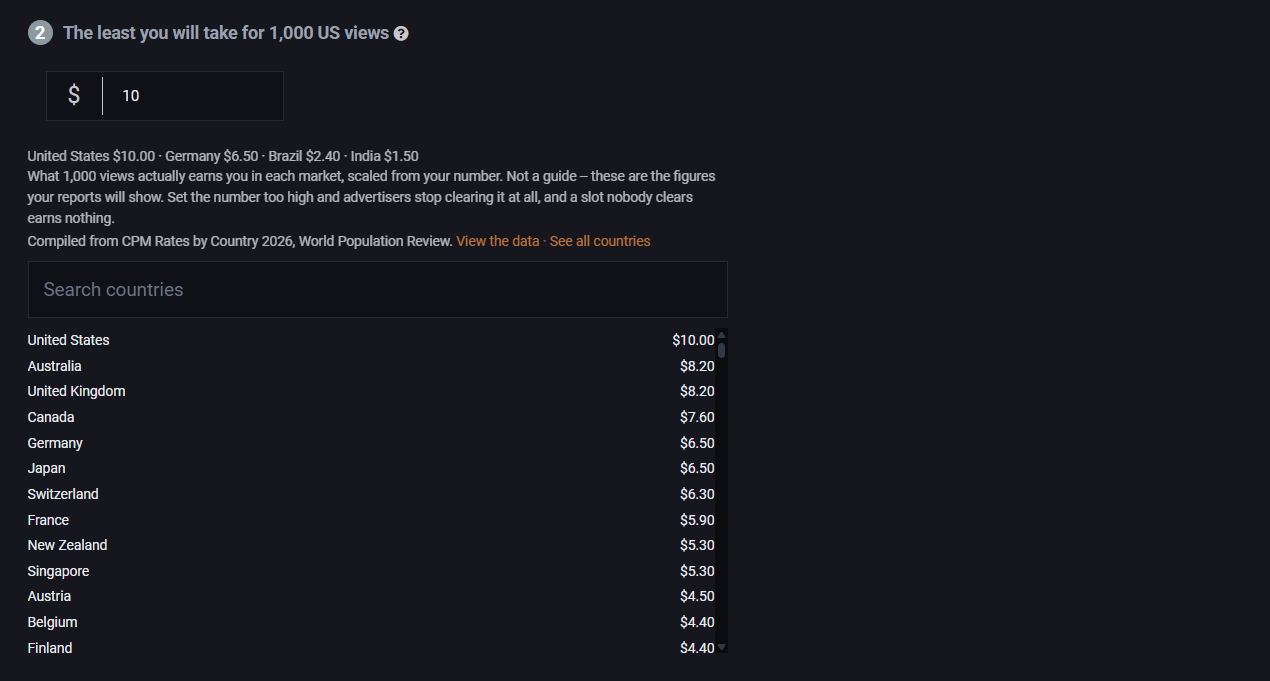
So when you see eight cents next to a country in that list, nothing has been taken from you. Eight cents is what a thousand views is worth there. The choice is between eight cents and nothing, because a view priced out of reach earns nothing at all.
Those figures are real prices, not a guide to them. A thousand views from a country on that list never sell for less than the number beside it, because every bid is scaled by the same share and no bid under your floor gets in. What is not settled is how many of them sell, and how far above your floor the advertisers who want the slot choose to bid.
Too high means empty
This is the one real risk. A floor nobody will meet does not earn you less per view, it earns you nothing, because the slot never sells and the ad never runs. An empty slot at four dollars pays exactly as well as no slot at all.
It is worth being clear about the arithmetic, because it surprises people:
| Floor | Views sold in a month | You earn |
|---|---|---|
| $4.00 | 0 | $0.00 |
| $1.00 | 20,000 | $20.00 |
| $0.40 | 90,000 | $36.00 |
The cheap floor wins, and it wins by a lot, because a slot that sells every time is earning around the clock while the expensive one sits empty.
What to actually set
If you have never sold advertising before, start between $0.50 and $1.50 and let it run for a week.
Then look at your reports:
- Almost no impressions. The floor is too high. Halve it and wait another week.
- Plenty of impressions and your eCPM is sitting right on your floor. Advertisers are paying your price and nobody is bidding above it. You can try raising the floor a little, but be ready to put it back.
- Plenty of impressions and your eCPM is well above your floor. Advertisers are bidding over it to win more of the slot. This is what you want. Leave it alone.
That third case is the reason not to be greedy at the start. A low floor fills the slot, a full slot attracts more advertisers, and competition raises your earnings without you touching the number again.
Visitors from outside the United States pull your eCPM below the number you typed, because their views sell at the country prices under the field. If most of your readers are elsewhere, compare your eCPM with those prices rather than with the US number.
eCPM is not the same as your floor
Your floor is what you set. Your eCPM is what you actually earned, worked out afterwards from the money and the views. The small e stands for effective, which is a long way of saying measured rather than asked for.
An advertiser sets a CPM. A publisher earns an eCPM. Same unit, opposite ends of the same transaction, and it is the single most useful number on your reports.
Different slots, different prices
The floor is set per zone, not once for your site, and that is deliberate. A slot at the top of your busiest page is worth more than one at the bottom of a page nobody scrolls to.
A reasonable starting spread:
- Above the content, seen immediately. Your highest floor.
- Inside an article or in a sidebar. The middle.
- Below the content, or on a quiet page. Your lowest. Something is better than nothing down there.
Changing it later
Open the zone from your zone list, change the number, save. It takes effect on the next auction, and the tag on your site does not change, so there is nothing to do on your own website.
Change one thing at a time and give it a week. A floor changed on Monday and changed again on Wednesday tells you nothing about either.
Where to go next
- Set your country prices, if the shares under the field are not what your market pays.
- What shows when nothing sells, which is what covers you while the floor is still settling.
- Read your reports, where eCPM lives.
Run all of this on your own site.
Every screenshot above is the real product. Your advertisers see the same screens under your brand, and on your own domain from the Pro plan.
Start free trial14 days free. Your existing ads keep running. Cancel anytime.